A corporate offsite on the Rio Arapiuns
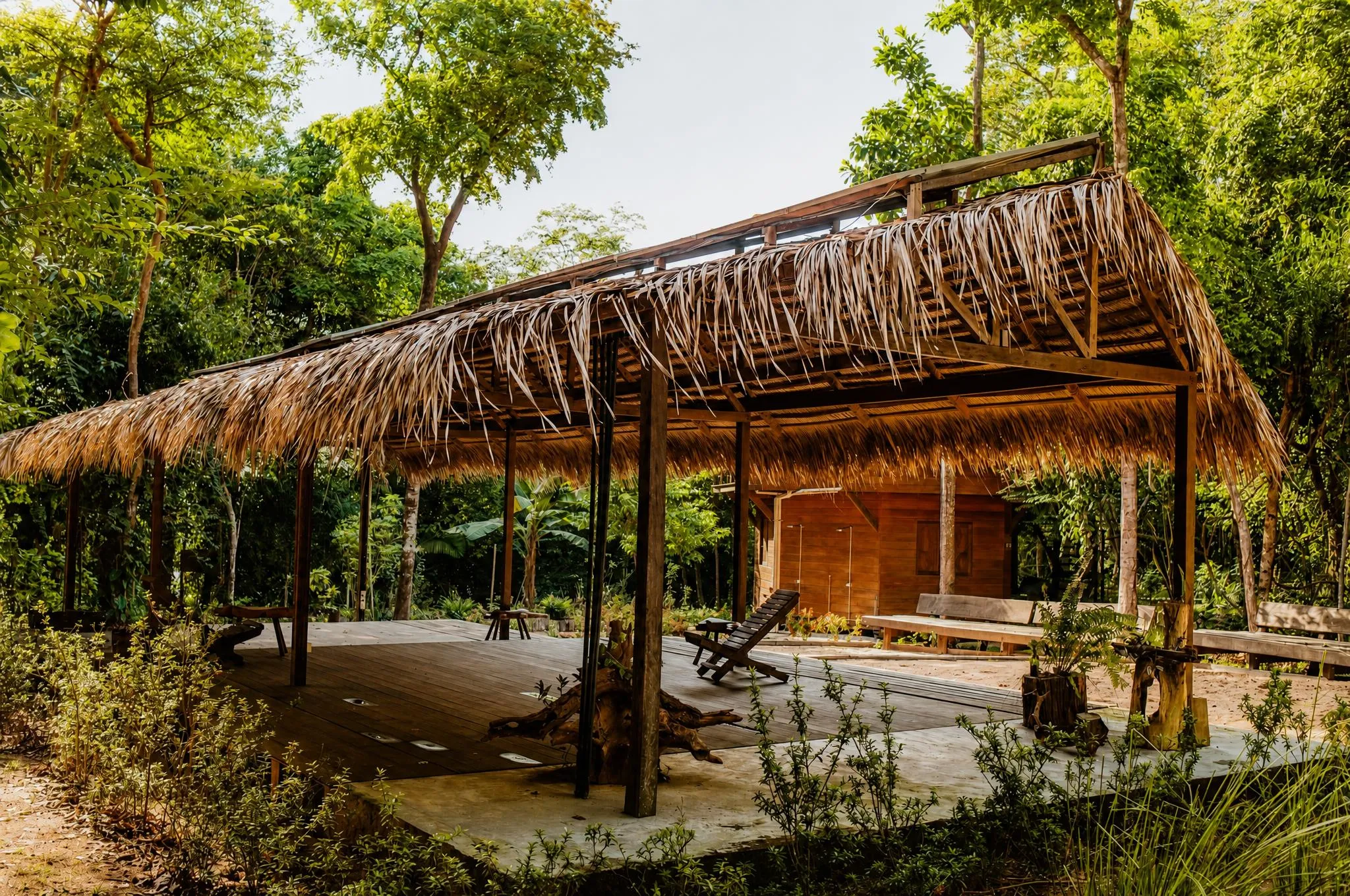
Villa Arapiuns hosts company teams on exclusive use of the whole property: thirteen bungalows for up to twenty-six people, a covered palm pavilion for plenary sessions, a dining hall where the whole team eats together, and a private beach on the Rio Arapiuns, an hour and a half by boat from Alter do Chão. Full board, solar power and a local team. Rates are quoted per group, by number of people and nights.
If you are choosing where to take a team, the question that matters is not whether the place is beautiful. It is whether it can carry your programme, whether the travel pays for itself, and whether you can contract it without it becoming a problem for your finance team.
This page answers all three — including the parts that may take us off your list.
What the place is
Thirteen bungalows on the bank of the Rio Arapiuns, in Pará, inside the Tapajós-Arapiuns Extractive Reserve — an hour and a half upriver by boat from Alter do Chão. Up to twenty-six people. Raised timber, palm-thatched roofs, solar power, and a team who live here.
On exclusive use, nobody outside your team is on site on those dates. That is the difference between an offsite and an incentive trip sharing breakfast with strangers.
Where the programme happens
The pavilion is the plenary room: a long palm-thatched structure, open on all four sides, that seats the whole team together. It is where the long session, the presentation and the strategy discussion fit.
The shala is the second space, enclosed enough for a smaller group to break away.
The dining hall — everyone at the same table, three times a day, for several days running. For a team that is as much a working space as the pavilion. It is where the conversations that do not fit the agenda happen.
The beach and the hammock grove are where people manage not to be in a session. An offsite without those two becomes a long meeting in an expensive place.
The connection works, and disconnection is your call
Worth being blunt here, because this is where most corporate decisions stall.
There is Starlink on stable solar power, and it carries the whole team through an online meeting at once. Nobody will be climbing a bank hunting for signal, and the mid-week call with head office happens. If that was your question, it is answered.
What changes is whose decision it is. Disconnection here does not come from the geography: it comes from you. If the point is to pull the team out of the flow for a few days, that becomes a rule leadership sets and announces — not a limitation the place imposes. Our advice is to settle it before travelling, because a team that arrives without an agreement will use the signal exactly as it would at the office.
The content the place already has
The part of the programme we do not have to invent: canoeing the flooded forest, the Samaúma trail out of the Atodi community, the cassava-flour process, palm weaving with the artisans, night dive-fishing taught by local fishermen.
These are led by the families who live from them and paid directly to them — so the team needs to bring cash in reais. This is not a team-building exercise designed by a consultancy: it is real work, done by the people who do it, with the team learning alongside. For most groups it produces more conversation than any designed exercise.
The piracaia — fish baked in the sand, in banana leaf, by candlelight, served in a circle on the beach — tends to close the last night without anyone having to design a closing ceremony.
Getting here
Fly to Santarém (STM), direct from Manaus, Belém and Brasília, connecting from São Paulo. Then 40 minutes by road and 90 minutes by boat.
Count a full travel day at each end. We arrange the boat as part of the group package; flights are on you.
What is not here
No spa, no gym, no enclosed meeting room with conference AV. There is a pavilion, a dining hall, a beach and a forest.
No beaches from February to June — the river rises and the sand goes under. It is a beautiful, different season, but do not sell your team a beach in April.
And we are not a plant-medicine venue. Said plainly, because the Amazon invites the assumption.
How we quote
The nightly rate depends on group size and number of nights, and falls as the group grows. We quote per group rather than publishing a fixed table.
Send the dates, how many people, how many nights, and what your programme actually needs from a space. You get a real number back.
Contracting
We invoice and we work with a group contract. A 30% deposit holds the date, and the balance is due in full seven days before check-in. We accept card and PIX.
Forty-eight hours to change your mind: cancel within that window, after signing and paying the deposit, and the refund is full. After that, cancelling more than sixty days before check-in retains 30% of the total, and at sixty days or less there is no refund. It is the last question a client’s finance team asks, and the one that most often decides against a country hotel — which is why it sits here and not only in the contract.
Frequently asked
Can the team work online from there?
Yes. There is Starlink on site, on stable solar power, and it carries the whole team through an online meeting at once. If your programme needs a call with head office mid-week, it happens — without anyone climbing a bank hunting for signal.
What presentation setup is there?
There is no sound or video setup on site. If your programme needs projection, sound or recording, production is contracted separately, and it is worth budgeting for that from the start. The pavilion gives you shelter, shade and the whole group together — the rest comes with you.
Do you invoice, and do you work with a contract?
Yes. We invoice and we work with a group contract. A 30% deposit holds the date, and the balance is due in full seven days before check-in, by card or PIX. The contract carries a 48-hour cooling-off window with a full refund; after that, cancelling more than sixty days before check-in retains 30% of the total, and at sixty days or less there is no refund.
How many people fit?
Thirteen bungalows, up to twenty-six people on exclusive use of the property — nobody outside your team is on site on those dates. We quote groups of different sizes; tell us how many you are and you get a number back.
How many nights make sense?
Getting here is a full day of travel, and getting back is another. From three nights up, the maths works. For a single night it does not — and we would rather say so before you build the budget.
When is the best window?
February to June is the flood season: no beaches, but silence, flooded forest and the widest whole-property availability. Weekdays from September to November bring the best weather of the year with broad beaches. December and January are high season and go first.
Want to see it for yourself?
The conversation starts on WhatsApp: tell us your dates and group size, and we will build the rest around them.
More reading
Host your retreat on the Rio Arapiuns
A whole-property retreat venue in the Brazilian Amazon: thirteen bungalows, a covered pavilion, a yoga shala and a private freshwater beach, for groups from fifteen guests.
August 31, 2026
What community-based tourism is — and how it works in practice
Community-based tourism isn't tourism with a community visit tacked on. It's tourism where the people who live there decide, run it, and get paid. How that works inside an extractive reserve on the Rio Arapiuns.
August 30, 2026
Tapajós or Rio Negro: which Amazon should you choose?
Almost every Brazilian Amazon lodge sits on the Rio Negro near Manaus. The Tapajós is the other option, and the two give you genuinely different trips. An honest comparison.
August 29, 2026